
Garagay: Millennial Ceremonial Center
Its walls, relief, art and colors keep more than 3,500 thousand years of history, an essential pre-Hispanic testimony to understand and learn about the great past of the city of Lima.
Located in the District of San Martin de Porres, it is made up of 3 large pyramids: the main one is in the center flanked from right to left by two other elongated pyramids (called arms), seen from the air they have the shape of the letter U, giving origin of the name “U-shaped Temple”. It is estimated that its construction began in the year 1400 BC, suffering throughout 800 years of history, until 600 BC, three major renovations. For this reason, archaeologists have named these three moments or phases as: Early Temple (to the first construction), Middle Temple (to the first great remodeling) and Late Temple to the aspect that it showed after the second and last great remodeling.
The technique that was used in these remodeling is the same that has been practiced since then and throughout the ancient history of Peru: They completely filled the old rooms and rooms with stone, earth or adobes and built new structures on top of it, gaining height . On the sides new walls were attached to the old ones, enlarging the horizontal dimensions. These remodelings covered the entire monument and its beginning must have been celebrated with festivals and rites, since offerings have been found that celebrated this fact.
The first excavations were carried out in 1959 by the archaeologists Manuel Ontaneda and Aquiles Ralli, as a result of their work reliefs painted with many colors were discovered and were associated with the Chavín Culture (900-500 BC), given the impossibility of preserving them, they had to bury the discoveries as a possible way to preserve them.
In 1961, during the construction of the Lima-Callao highway to the new Jorge Chávez International Airport, Constructora Dos de Mayo used the Huaca de Garagay as a quarry, destroying part of one of the side pyramids.
Another intervention was carried out in 1974 by the archaeologists Rogger Ravines and William H. Research, delimitation and conservation work was carried out on the Huaca Garagay. They discovered the impressive polychrome reliefs in two of its pyramids, as well as the discovery of thousands of ceramic and textile objects that demonstrated its great antiquity, determining that Garagay is prior to Chavín de Huántar and not the other way around as was initially believed.
First Temples and Civilizations in the city of Lima
Around 2000 B.C. the coastal valleys of Peru (such as Lima) did not have the ideal conditions to live in, the sandy soil was not suitable for the practice of agriculture and the rivers with their seasonal floods and overflows were uncontrollable. 3,500 years of hard work turned the Lima plain into the fertile valley it was until 1960, and today it has disappeared due to the rapid growth of the city.
The improvement of agriculture, the exploitation of the fruits of the sea (especially the collection of shellfish on a large scale) and the use of new technologies allowed the growth of the population and with it the appearance of complex societies, which in archeology we call ” cultures” (for example: the Moche culture, the Paracas culture, etc.). The oldest in Lima is called “of the U-shaped Temples”. Garagay is a “Temple in U”.
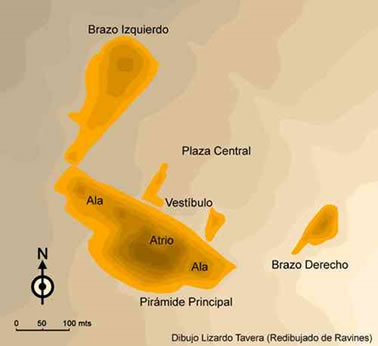
In the 1960s, aerial photos were used to locate archaeological sites in large areas (entire valleys) and thus facilitate subsequent visits. This is how it is detected that among the valleys of Huaura, Chancay, Chillón, Rímac and Lurín there were these sets of three pyramids with the said U-shape. The architect Carlos Williams, very dedicated to archaeology, in his pioneering article of 1971: “Early Ceremonial Centers in the Valleys of Chillón Rímac and Lurín” (Archaeological Notes magazine N. 1) “discovers” them and defines their main characteristics.
The works of Ravines and Isbell in 1974 in Garagay open a new page in the history of Lima by unearthing what is probably the oldest civilization in the central coast of Peru, a region that was one of the main sources of cultural irradiation in the Andes (in turn, the Peruvian Andes, are one of the 6 original centers of culture in the world, along with Mesoamerica, Mesopotamia, China, India and Egypt). Richard Burger working in Cardal, Mina Perdida and Manchay (other U-shaped Temples in the Lurín Valley) since the mid-1980s and other researchers who have worked on a smaller scale end up initially delineating this important culture .
The Main Pyramid
It is the largest structure and center of the entire complex. In the center and keeping the same orientation as the U-shape (in Garagay it is 32º north-northeast), a long and wide staircase climbs the 23 meters that separate the top of the pyramid from the plaza. At the top the “atrium” receives the visitor. This is a square room (24 meters per side) with a main entrance that overlooks the Central Plaza from above. It is considered the most important place, the center of everything and the main sacred space for the men of that time. It is here that the friezes and faces of gods and the offerings that the devout believers deposited them were discovered. The one we can see today is the atrium of the Middle Temple, since the atrium of the Late Temple was destroyed by looters and over the years, almost completely disappearing.
For its construction, semi-edged stones (cut, but not polished, generally irregularly shaped) were used, joined with mud to form cells that were filled with bags full of stone and earth made with networks of vegetable fibers called “shicras”. The external walls are plastered with a 2-centimetre-thick clay plaster as a base, two more layers of 15 millimeters each and a highly polished final layer of 1 centimeter.
In the Main Pyramid it is the “atrium” of the “Middle Temple” phase that can be seen with the naked eye. Ravines and Isbell excavated half of this enclosure, the other half is still buried waiting to be studied and contribute its own to history. The Early Temple “atrium” is below its Middle Temple counterpart. To study and learn about it, it would be necessary to dismantle or destroy the “atrium” of the Middle Temple in order to get to where it is. A real dilemma for science.
The Friezes
The friezes found in 1959 (as we wrote above) and that were destroyed shortly after corresponded to the Late Temple. An offering deposited during the last remodeling is a stone slab covered with plaster on which the image of a god was painted that Ravines and Isbell find similar to the one represented in the Lanzón Monolithic of Chavín, located in an internal gallery of the Old Temple of Chavín de Huántar: Therefore, the Old Temple of Chavín (the oldest) would be from the same period as the Late Temple of Garagay (the most modern).
The friezes (figures modeled and painted against a wall) of the Middle Temple of Garagay show some characteristics that centuries later would form part of the art represented in Chavín de Huántar, for this reason it is considered that part of the legacy originated from this place, which Added to that of other regions of Peru, it modeled the Chavín phenomenon, also known as the Early Horizon (1000 – 200 BC), whose influence was felt in much of ancient Peru.
There are two most outstanding representations, due to their state of conservation, in the atrium of the Greater Pyramid: “the spider” and the “medallion”. Regarding the first, there is no consensus as to whether it represents some being of nature or is an abstract representation with many attributes. For the archaeologist Richard Burger, the first motif would represent a spider, since it resembles it in shape, and in ancient Peru they were taken as messengers of the rains and used in propitiatory rituals in times of drought.
To paint these friezes, pigments of mineral origin (aluminum and calcium) were used, using the sumo of the cactus called San Pedro (Trichocerus pachanoi) as an agent. For the application on the reliefs, cotton specks were used. The colors used were black, white, yellow, greyish blue, red and pink as background colour.
Diet
From their excavations in the Principal Pyramid and the Right Arm, Ravines and Isbell recovered 95 kilos of shellfish remains, representing an approximate 8,000 specimens. These remains were found as part of the construction fillings, mainly. The beach is 6 kilometers away and the 17 species present in Garagay come from 3 ecological zones: sandy bottom, rocky bottom (farallones) and stony bottom. Which means that the inhabitants of Garagay had a very varied marine diet. A case to highlight is that of a valve of “Choro” (Choromitylus chorus) used as a deposit of red pigments. Regarding the vegetable diet, archaeologists have found remains of corn, pacay (Inga feuillei), peanuts (Arachis hypogaea), beans (phaseolus vulgaris), lucuma (Lucuma Obovata), pumpkin (Cucurbita pepo) and Pumpkin (Cucurbita maxima). .
Conclusions
Garagay, was a Ceremonial Center that served to unify family groups scattered in the valley, but linked together by invisible but very strong cultural ties. They developed a civilization based on agriculture as their main source of livelihood and fishing/seafood gathering as a secondary source. They built large, elaborate and sumptuous buildings. They were governed by a ceremonial calendar that marked fixed holidays in which the inhabitants of this temple required the participation of the entire surrounding population.

Bibliography:
https://www.arqueologiadelperu.com.ar/garagay.htm
RAVINES Rogger
1982 on the formation of Chavín: images and symbols. Lima Newsletter. Year 6 No. 35.
1975 Garagay: An old Temple of the Andes. Textual. Magazine of the National Institute of Culture No 10.